ADHD Coach vs AI Coach: Which One Do You Actually Need?
A human ADHD coach and an AI coach do different jobs. Here is what each one is good at, what the research says, and how to decide which you need, or whether you need both.
By Julian · · 13 min read
The short version
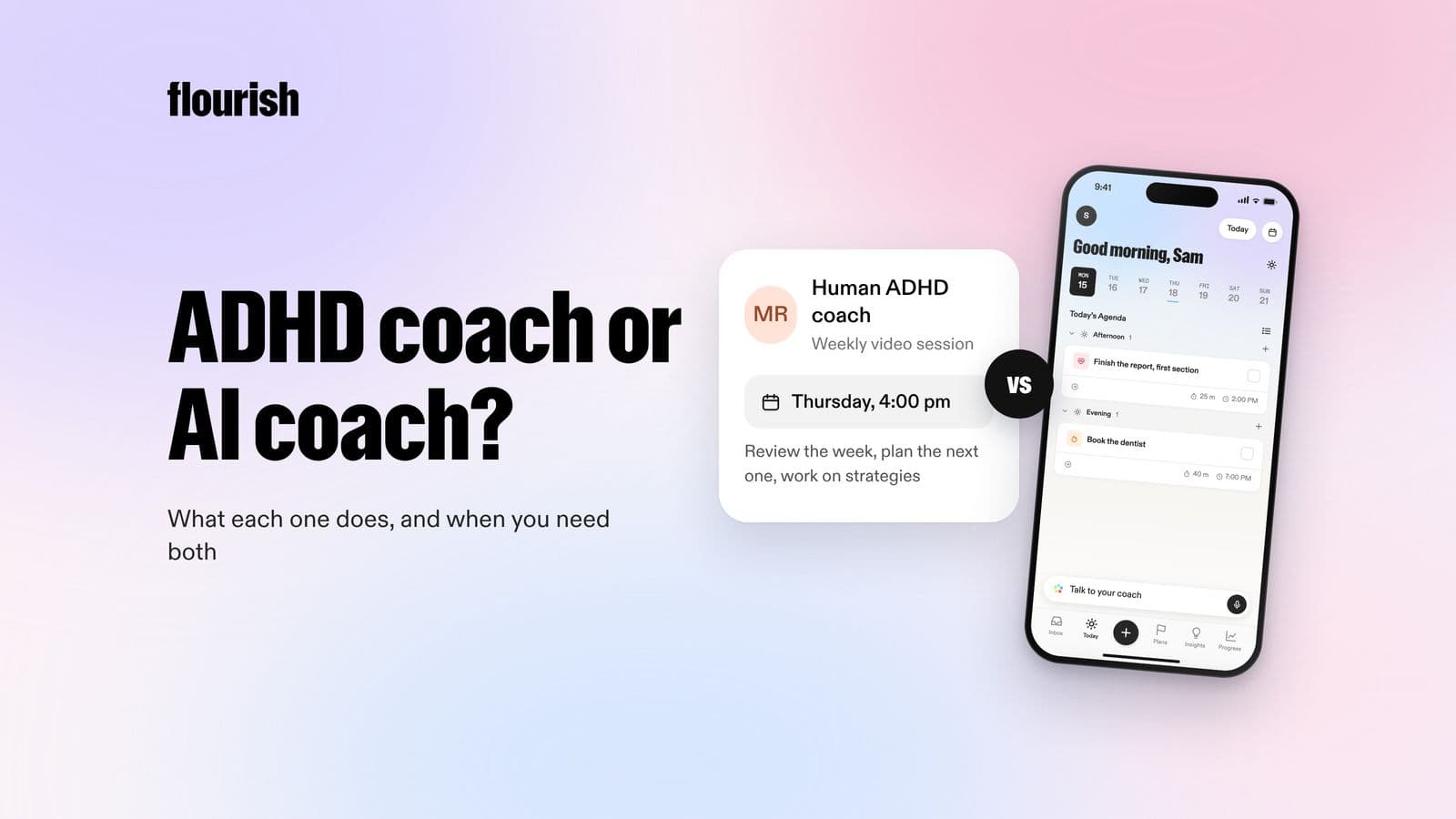
A human ADHD coach and an AI coach do different jobs, so the honest answer is that many people need one for a while and some benefit from both. An AI coach such as Flourish is good at the daily layer: getting everything out of your head, picking what to do today and checking in between the moments you would remember to ask for help. A human ADHD coach brings things software cannot: judgement about your whole life, a relationship that makes accountability feel real, and strategies tailored by someone who has seen hundreds of people get stuck in the same places. If you are not sure where to begin, an AI coach is a low-pressure starting point, and a human coach is worth adding when the same patterns keep repeating. Neither is treatment. Coaching does not replace an ADHD assessment, medication or therapy. If attention, organisation or low mood are getting in the way of work, study or relationships, speak to your GP or a qualified clinician first, and use coaching alongside whatever they recommend.
What does an ADHD coach actually do?
ADHD coaching is a practical, goal-focused partnership. CHADD, the US national ADHD organisation, describes it as an approach that targets core ADHD challenges such as planning, time management and goal setting. A coach mostly asks questions that help you notice your own patterns and find your own answers, then adds encouragement, feedback, reminders and accountability between sessions. In practice, that tends to look like:
- A longer first session to understand your goals, your days and where things usually fall apart.
- Regular sessions, often 30 to 60 minutes, where you review the week and plan the next one.
- Small, concrete commitments ("I will open the tax return on Thursday at 9am and fill in page one") rather than big resolutions.
- Check-ins between sessions, by message or a quick call, depending on the coach.
- Building external structure: routines, reminders and environments that do the remembering for you.
What a coach does not do matters just as much. CHADD is clear that coaching complements medication and other approaches and that coaches do not diagnose or treat mental health conditions unless they are also licensed clinicians. Coaching is also not therapy. It looks forward at actions and habits, and it is not designed to work through trauma, grief or deep emotional difficulty. ADHD coaching has a longer history than most people expect. ADDA, the Attention Deficit Disorder Association, published one of the first sets of guiding principles for coaching people with ADHD in the early 2000s, describing coaching as a natural fit for adults because it grew out of adult learning models.
How do you know an ADHD coach is qualified?
Coaching is not a regulated profession, so anyone can call themselves an ADHD coach. That makes credentials and experience worth checking. The main ones you will see:
- PAAC, the Professional Association for ADHD Coaches, is a credentialing body dedicated to ADHD coaching. It offers tiered credentials (PCAC, Professional Certified ADHD Coach, is the one you will see most often in coach bios) and runs a Find a Coach directory.
- ICF, the International Coaching Federation, offers general coaching credentials at three levels, ACC, PCC and MCC, each requiring set hours of training and coaching experience. ICF does not have an ADHD-specific credential, but some ADHD coach training programmes count towards it.
- Training and experience. CHADD suggests asking about a coach's education, ADHD-specific training and how long they have worked with clients like you.
A good first conversation should also tell you how the coach handles things outside their scope. A qualified coach will tell you when something sounds like it needs a clinician, not a coach.
Does ADHD coaching work? What the research says
The evidence is encouraging but still young. The most cited overview is a descriptive review of ADHD coaching research (Ahmann et al., 2018) in the Journal of Postsecondary Education and Disability. The authors found 19 quantitative and qualitative studies of coaching outcomes, 10 of them focused on college students. All 19 reported that coaching supported improvements in ADHD symptoms and executive functioning, most of the quantitative studies reported statistically significant benefits, six reported better wellbeing and three showed gains were maintained over time. More recent work points the same way. A 2026 prospective study of 12 coaching sessions for adults with ADHD (Ahmann et al., 2026) found statistically significant improvements in ADHD symptoms, executive functioning and day-to-day impairment, with medium to large effect sizes. The caveats are real. Many studies are small, many have no control group, a lot of the research is on college students, and the 2026 study's authors note that their sample was fairly similar in gender, race and education. So the fair summary is: coaching looks helpful for planning, follow-through and confidence, as one part of a wider plan, but it is not proven to the standard of medication or therapy. There is far less research on AI coaching for ADHD specifically. What the coaching research does suggest is that the active ingredients are regular, structured check-ins, small concrete goals and external accountability. Those are exactly the parts an AI coach can deliver every day, and the parts a human coach delivers with more depth.
What can an AI coach do, and what can it not?
An AI coach is software that talks with you about your goals and days, remembers context and helps you decide what to do next. The good ones also reach out to you first, which matters a great deal for ADHD brains, where the problem is rarely knowing what to do and more often remembering, starting and choosing. What an AI coach does well:
- It is there at 7:40 on a Tuesday morning, or at 11pm when your head will not switch off.
- It does not get tired of you dumping the same twenty worries for the fifth day in a row.
- It turns messy talk into something structured, such as a sorted, prioritised list and one clear next step.
- It can check in daily, which is more often than most human coaching arrangements allow.
- There is no social pressure. Some people find it easier to admit "I did nothing today" to an app than to a person.
What it cannot do:
- It cannot read the room. It will not notice that your voice sounds flat or that you keep avoiding one topic.
- Its judgement is limited to what you tell it. A human coach can challenge a plan that is technically sensible but wrong for you.
- The accountability is softer. Letting down a person you see every week feels different from ignoring a notification.
- It is not equipped for a crisis. If you are struggling to stay safe, contact emergency services or a crisis line, such as Samaritans on 116 123 in the UK or 988 in the US.
- It is not clinical. No AI coach can assess ADHD, adjust medication or provide therapy.
If you want a wider view of the AI options, our guide to the best AI life coach apps compares them on memory, proactive check-ins and daily planning.
ADHD coach vs AI coach: side by side
- Availability: human coach: scheduled sessions plus whatever between-session contact they offer. AI coach: any time, every day.
- Memory: human coach: remembers your story, your history and the things you did not say. AI coach: remembers what you have told it, within what the app stores.
- Judgement: human coach: strong, from training and experience with many clients. AI coach: limited, and only as good as the context you give it.
- Proactive check-ins: human coach: yes, within agreed limits. AI coach: depends on the app. Some reach out daily, many wait for you to open them.
- Personalisation: human coach: deep, built over weeks of conversation. AI coach: grows with use, but based on patterns in what you share.
- Accountability: human coach: strong, because a real person is expecting you. AI coach: lighter, but more frequent.
- Privacy: human coach: bound by their professional code and your agreement. AI coach: depends on the provider's data policy, so read it.
- Crisis support: human coach: will refer you on, but is not a crisis service. AI coach: not suitable. Use emergency services or a crisis line.

Which one do you need?
The quickest way to decide is to look at where your days actually break down, then match the support to it. Start with an AI coach if:
- Your main problem is the daily handover from a crowded head to a first action.
- You want help most days, at unpredictable times, rather than once a week.
- You are curious about coaching but not ready to talk to a stranger about how messy things feel.
- You often freeze when every task feels equally urgent. Our guide to ADHD paralysis explains why one clear next step works better than a long list.
Add a human ADHD coach if:
- You keep making plans that fall apart in the same way, and you cannot see why.
- You are facing a big transition: a new job, starting university, becoming a parent, starting a business.
- You need the kind of accountability that only comes from someone you do not want to let down.
- You want strategies built around your specific work, family and history, not a general method.
Use both if:
- You have a human coach and the week between sessions is where everything slips.
- You want your sessions to be about patterns and strategy, not reconstructing what happened on Tuesday.
Talk to a clinician first if:
- You suspect ADHD but have never been assessed, or you are diagnosed and struggling despite treatment.
- Low mood, anxiety, sleep problems or burnout are part of the picture.
- Things are getting harder rather than easier, whatever you try.
In the UK, the NHS advises seeing a GP if ADHD symptoms are affecting your studies, work or relationships. Your GP can refer you for a specialist assessment, and treatment can include medicine and CBT, with coaching as a useful extra rather than a replacement.

How to combine a human coach and an AI coach
Used together, the two cover each other's gaps. The human coach handles strategy, judgement and the honest conversations. The AI coach handles the daily loop of capturing, choosing and checking in. A simple way to set it up:
- Agree on two or three goals with your human coach. Keep them concrete and small enough to act on this week.
- Use the AI coach every day to empty your head and pick one thing that moves those goals forward.
- Let the AI coach check in during the week, so a missed day becomes a restart rather than a spiral.
- Bring what you noticed to your next session. "I kept skipping the admin task on Mondays" is far more useful to a coach than "the week went badly".
- Adjust together. The human coach changes the strategy; the AI coach keeps running the daily routine.
If accountability is the main thing you need, our comparison of AI accountability partner apps looks at which tools actually follow up. And if you are building the wider system around coaching, the best ADHD apps for adults and the best ADHD planner apps cover capture, planning and focus tools.
Where Flourish fits

Flourish is an AI coaching app for planning and follow-through, on iOS and Android. It is not an ADHD coach and it is not a clinical tool. It is designed for people with a heavy mental load, including many adults with ADHD, who know what matters to them but lose the thread in the day to day. You start by talking. You ramble everything on your mind into a voice brain dump, and Flourish sorts it into tasks, prioritises them and gives you one clear to-do for the day. That to-do also sits on your phone's lock screen, so the most important thing is the first thing you see, not buried in a list. Then the coach reaches out to you. It checks in proactively to help you plan, challenges what you are about to spend your time on, and gives insight, accountability and support when a day goes sideways. That is the part most people miss when they try to coach themselves with a list app: you do not have to remember to ask for help. It can also connect your calendar, wearables and Gmail inbox, so the plan fits the day you actually have. Where it fits in this comparison:
- On its own, it covers the daily layer: capture, prioritising and follow-through.
- Alongside a human ADHD coach, it handles the days between sessions.
- Alongside clinical care, it is a practical support tool, not a treatment.
What about ChatGPT, or apps with human coaches?
Two other routes come up a lot. ChatGPT can be a very good thinking partner for ADHD brains. It can break a scary task into steps, draft an awkward email or help you talk through a decision. With memory switched on, it can recall saved details and past chats, and scheduled tasks let it send you a reminder or a recurring prompt. The limitation is that you drive it: it will not notice a plan has slipped or decide to check in unless you set that up in advance. Some apps connect you with human ADHD coaches. Shimmer, for example, offers weekly 30-minute video sessions with an ADHD coach, messaging between sessions and group body-doubling calls. It lists coach credentials including ICF and PAAC, though credentials vary across its roster, so check the coach you are matched with.
The verdict
An ADHD coach and an AI coach are not rivals. A human coach is the better choice for judgement, deep personal strategy and accountability you feel, especially during big life changes. An AI coach is the better choice for the daily work of getting thoughts out, choosing what matters and getting a nudge when you drift. If you are starting out, try an AI coach and see where you still get stuck; if the same patterns keep repeating, add a human coach. Flourish is built for that daily layer: talk it out, get one clear to-do and let the coach check in. And whichever route you choose, coaching sits alongside proper assessment and treatment, never instead of it.
Frequently asked questions
Is an AI ADHD coach worth it?
An AI coach is worth trying if your main struggle is daily follow-through: deciding what to do first, getting started and restarting after a bad day. It is available whenever you need it and can check in on you. It will not match a human coach's judgement or the accountability of a real relationship, and it is not a substitute for assessment or treatment.
Can an AI coach replace a human ADHD coach?
Not fully. An AI coach can handle a lot of the daily structure that coaching provides, such as capturing tasks, prioritising and check-ins. A human coach adds judgement, empathy and strategy shaped around your whole life. Many people find an AI coach is enough day to day, and add a human coach when patterns keep repeating or life changes.
What qualifications should an ADHD coach have?
Coaching is not regulated, so check carefully. Look for an ADHD-specific credential from the Professional Association for ADHD Coaches (PAAC), a general coaching credential from the International Coaching Federation (ICF) at ACC, PCC or MCC level, and real experience with adults with ADHD. A good coach also knows when to refer you to a clinician.
Is ADHD coaching the same as therapy?
No. Coaching focuses on goals, habits, planning and accountability, and it looks forward at what you will do next. Therapy, such as CBT, is delivered by a qualified clinician and can address emotional difficulties, anxiety, low mood and deeper patterns. Coaches do not diagnose or treat conditions. Many people use both, with coaching supporting the practical side.
Do I need an ADHD diagnosis to use a coach?
No. Both human coaches and AI coaches can help with planning and follow-through whether or not you have a diagnosis. That said, if you suspect ADHD and it is affecting work, study or relationships, it is worth speaking to your GP about an assessment, because diagnosis can open up treatment options that coaching cannot provide.
Can I use an AI coach and a human coach at the same time?
Yes, and it often works well. Use the human coach for strategy, reflection and bigger goals, and the AI coach for the days in between: emptying your head, choosing one thing to do and getting a check-in when you drift. Bring what you noticed during the week to each session so the time goes on patterns.
This article is for general information and is not medical advice.
Keep reading

Julian
Flourishing Writer